Grok-4.5 is the summer surprise model drop of the season.
After slowly falling behind from being a competitive frontier lab, the now amalgamated SpaceXAI Grok-4.5 model has got people talking.
It effectively offers Opus-4.8 / GPT-5.5 level intelligence, at a fraction of the price, and very fast tok/s – especially if you’re using Grok Build.
While that may not seem like anything too incredible, it is hard to describe just how transformative the experience of using Grok Build with Grok-4.5 is. Grok Build has gone from a buggy Claude Code clone, to a truly delightful yet professional offering.
No “Thinking...”, “Falootening...”, “Imagining...”, “Licking toes...” as you wait for it to work.
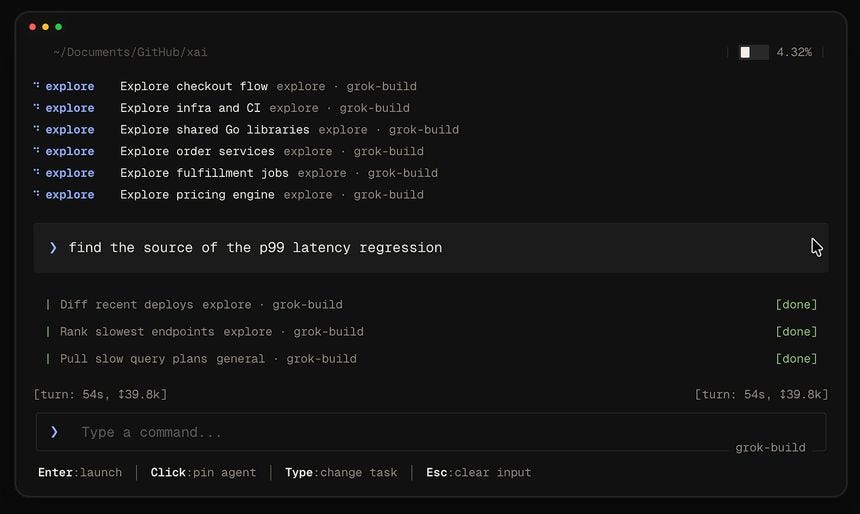
Instead of all the goofy EA Silicon Valley nerd Easter Eggs in Claude Code emerging from the increasingly troubling cult of Anthropic, Grok Build is ruthlessly pragmatic and just gets to work. A simple blinking dot for the bullet points as it runs through the task list at lightning speed, and in parallel. Grok Build effortlessly kicks off sub-agents to speed through parallelizable work.
Endless backlog of Sentry Issues from production exceptions? Put Grok Build with Grok-4.5 on it and you’ll have 50 fix PRs ready to merge in 10 minutes.
While other model releases like Anthropic’s Fable 5 or OpenAI’s GPT-5.6 Sol have competed solely on intelligence, largely disregarding cost and speed, Grok-4.5 is a breath of fresh air offering true efficient frontier of “good enough” intelligence, cheap and fast.
Hire me as CTO or tech lead for your next project.
Focus on growing the business, never worry about the tech again.
Slide into my DMs on X or Substack. Select portfolio at Deca Labs.
After being hooked for months on Conductor, the Mac App which wraps Claude Code and Codex TUIs (terminal user interfaces) with nice chrome and git worktree handling, I was not stoked to be forced back to the terminal just to use Grok-4.5.
I could have tried to get the still buggy OpenCode Conductor integration to work through OpenRouter but that was getting so frustrating in recent weeks I was ready to give it a break as they work out the kinks.
So, back to the terminal with Grok Build. And the speed really is a revelation.
With slow models, I’ve slowly gotten used to having to work in parallel, 5-15 active git worktrees at any given time, some with agents humming away, others with finished work ready for me to review. The bottleneck had quickly become my ability to review, do final manual verification, and merge the PRs.
The context switching cost adds up and I’ve been finding myself mentally exhausted more than in the pre-AI times when I could joyfully focus on a single hard problem for a whole afternoon, or even a few days, if I was successful at delaying useless meetings with my manager or team.
Grok Build with Grok-4.5 is so fast, that for the first time in 18 months, I can largely work synchronously again. Cutting my parallel work from 15 down to 3-5 has been a huge win, and honestly is a lot more fun to sprint through one task, merge it, and then move on to the next.
Use Poaster’s custom AI model to pull the best quotes from your long form writing, and automatically post them to your socials.
Skip the army of virtual assistants, start today for $1/month.
Grok-4.5 + Hermes
After reluctantly trying Grok Build with a free trial, within a few hours I was hooked, had blown through my quota, and upgraded to SuperGrok Heavy.
At $300/m, SuperGrok Heavy is only worth it if you are hitting quota usage caps. But with the ability to use it with Hermes, I decided to give it a shot this month and jump from my nearly $800/m run rate I had going with OpenRouter for Z GLM 5.2.
So far, Grok-4.5 within Hermes has been a delight, slightly slower than using Grok Build TUI directly, but much faster the Z GLM 5.2 and I think in coding cases especially slightly better results (though Z GLM 5.2 was more than good enough).
The other stand out feature of Grok-4.5 is the AI video and photo generation capabilities, which is truly industry leading, included in your SuperGrok subscription, and Hermes ships with included skills and tool to make it easy to use.
AI generated ads are now at your fingertips, and with some refined process and prompts are quite impressive.
What I’ve found work well has been to tell it to write a scene by scene script first, then generate the videos from the clips with music. Guiding a more structured process within the prompt has vastly improved my results, and with a after a bit of back and forth iterating, the final product is now ready to upload to Meta ad manager or TikTok.
Thank you to the readers who pay to make this newsletter possible.
Ready to turn your life around? Subscribe & start here and report back your wins.
– Fullstack
This Substack is reader-supported. To receive new posts and support my work, consider becoming a free or paid subscriber.
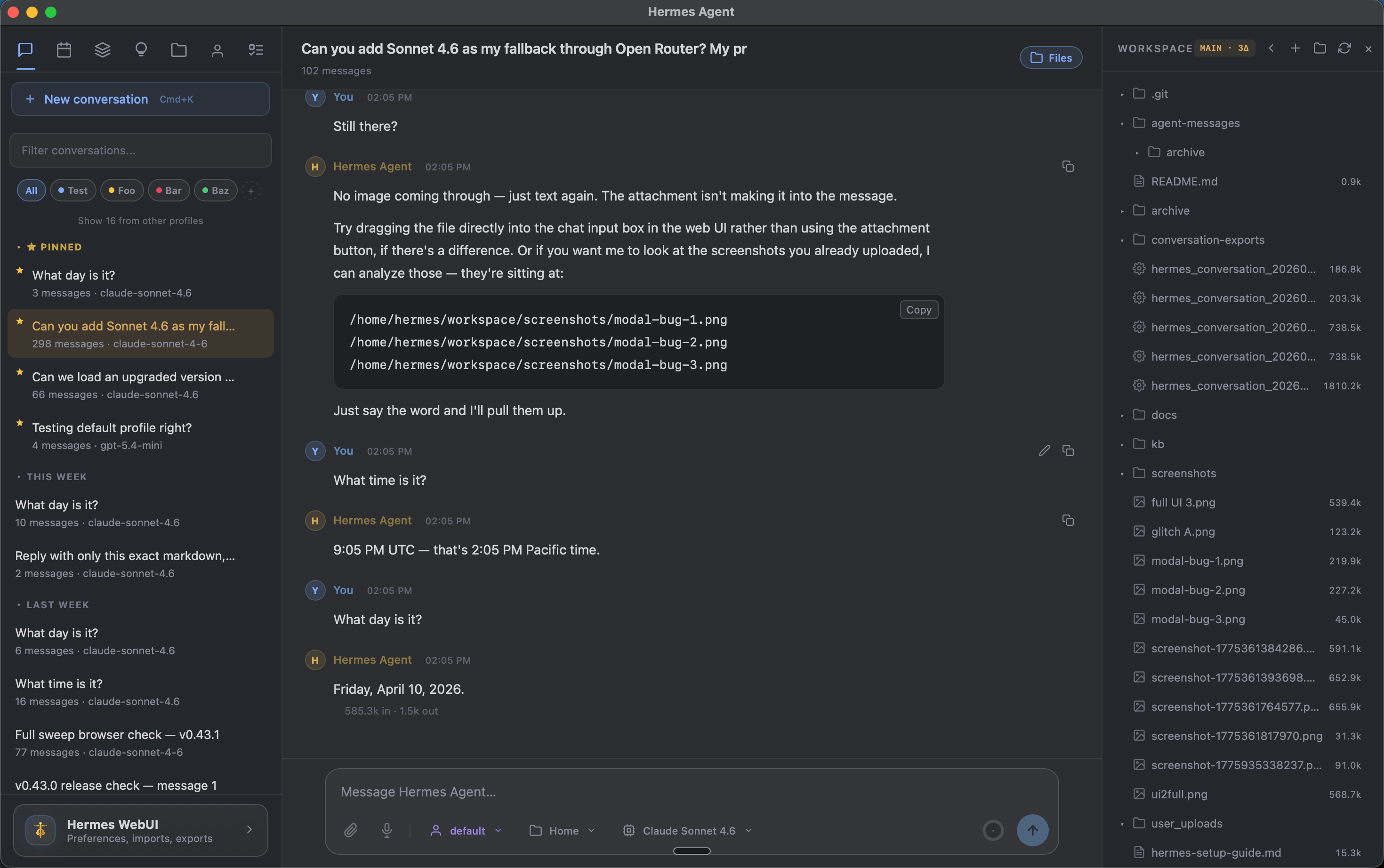
Hermes Web UI + Hermes Desktop App
This has been a grab bag of a post so far, but let’s keep the party going.
What an upgrade from only interacting with Hermes through Slack or Telegram.
Both offer a much more robust interface, closer to Conductor, which exposes much more details on tool calls, errors, and it’s all expandable unlike in Slack or Telegram where the message sent is the message, minimal interactivity or monitoring complex tasks.
Hermes Web UI even works well on my phone, so with Tailscale or your own home VPN solution, it’s easy to stay within the same interface you’re used to on desktop as you monitor your agents’s progress on the go.
I’m finally getting close to the level of W2 “work on the go” that I had achieved in pre-AI days with Slack + Github mobile app – though back then “working hard” was just reviewing a few PRs and replying to some Slack messages. Now that I can kick off PRs and investigations easily, I’m no longer chained to my desk which was getting old really fast.
Coming Soon: my personal SCR (Strategic Compute Reserve)
While I’m able to expense token plans through work, I’ll probably continue to do so, though am itching to secure some local compute to provide some resiliency to the looming risk of opensource models and compute being banned.
With Mac Studio M5 Ultra around the corner, DGX Spark clones abounding, and material optimizations for local models dropping every week, the time to buy may soon be here.
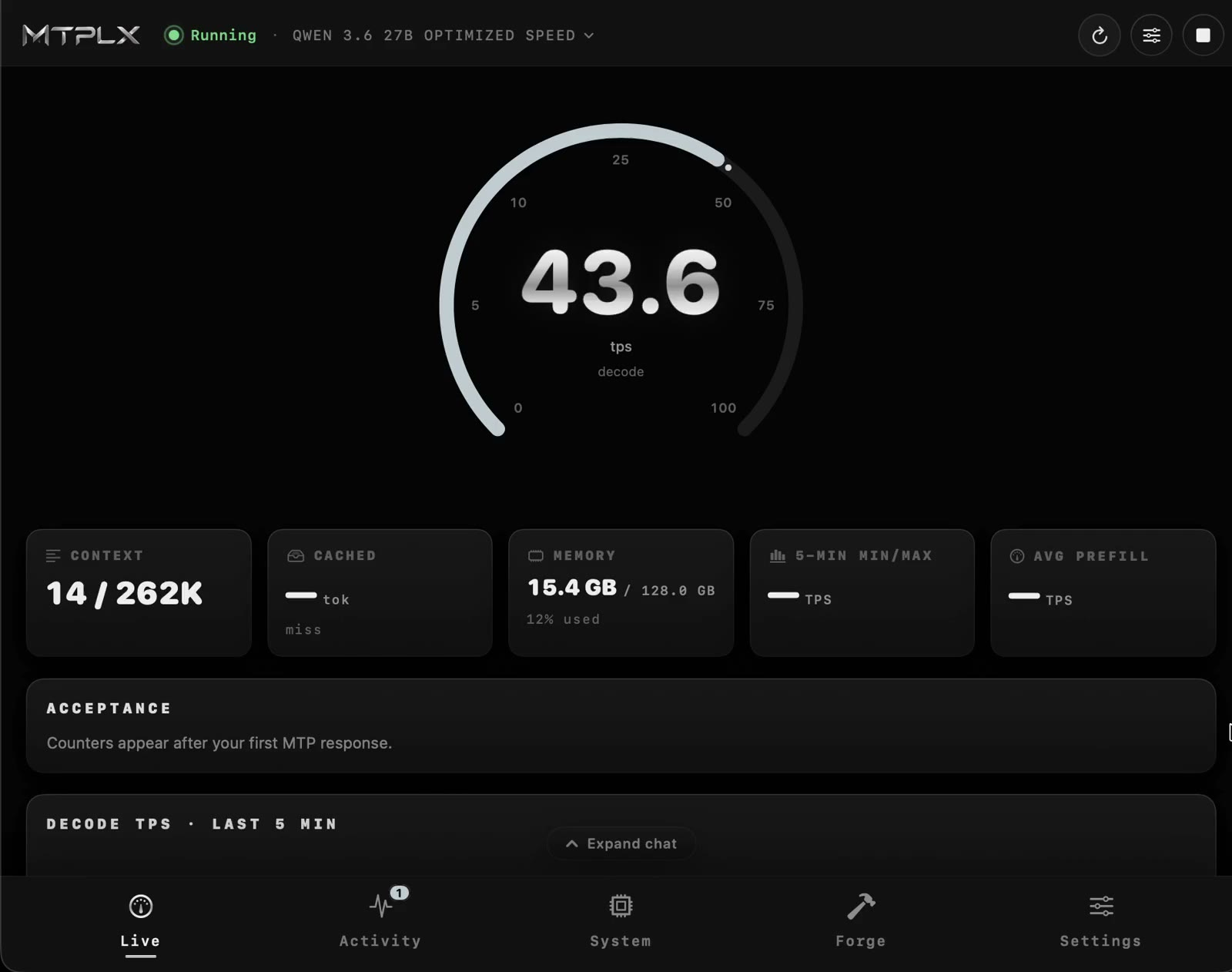
In the meantime, I’ve been experimenting extensively with my M4 Max 128GB and M3 Max 64GB which easily host Qwen3.6-35b as a local backing model for Hermes. And with a recent new opensource app called MTPLX, I’ve now been hosting Qwen3.6-27b at 30-40 tok/s which is shockingly usable given I was barely getting 13 tok/s before.
M5 users have reported 45-70 tok/s with the added neural and pre-fill accelerators in that generation, so I’m expecting when the M5 Ultra finally drops for it to put up good numbers.
Local for most people won’t be Grok-4.5 fast for a long time, but it could make Z GLM 5.2 usable for slow async overnight work. And with that approach you could move 1-2B of token spend per month to local compute with no additional cost other than electricity, and with the added security that the compute and downloaded models are yours, not to be removed at the whim of a company or government.
Anthropic Fable 5 vs. OpenAI GPT-5.6 Sol
Somewhat burying the lede, but for most the big drop this week was OpenAI GPT-5.6 Sol, their much awaited response to Anthropic’s Fable 5 which initially was released almost a month ago, though promptly yanked after their fear mongering of it’s capabilities made way to the White House by way of snitches at Amazon and an export control ban forced Anthropic to pull access for 19 days.
While Fable is now back, it is both incredibly slow and expensive, with many complaining of just 3 or 4 prompts using their entire monthly plan’s quota, and API costs even for moderate use easily hitting over $500 in 4 hours. Furthermore, for countless tasks it silently drops down to Opus-4.8 anyways because of the draconian safety controls on it, meaning its largely unusable for regular coding tasks outside of long, slow architecture planning or debugging runs.
OpenAI GPT-5.6 Sol has managed to strike a better balance of usability with no forced model swaps for safety controls, and better economics than Fable, though still many complaining online that it quickly uses up quota compared to GPT-5.5. The complexity of GPT-5.6 with Sol, Terra, Luna, with low to xhigh variants for each continues to make OpenAI usage some of the most operationally complex with endless knobs and axes of model size vs. thinking difficulty to consider, with parallel cost and speed dimensions not always intuitively related to each.
In my limited testing, GPT-5.6 certainly lived up to the praises many were giving it for excellent UI design and implementation. I had it take a basic PWA mobile app I had built with Z GLM 5.2 and modernize the UI and it now looks as polished as any production app that Silicon Valley has put out with an army of mobile devs. For marketing and ecommerce websites, it easily one-shots output that used to cost 5-figures to a boutique marketing agency stacked with designers and developers.
Many report even improved performance on hard debugging compared to Fable, despite mixed performance on benchmarks which put it neck and neck but not necessarily a clear winner.
Though, there have now been many reports of GPT-5.6 attempting to delete user’s home directory or all the files on their server, proving yet again that non-deterministic models can not be trusted with unsupervised full access to anything of value.
Many including myself are working on more robust sandbox tools which they can’t escape given the vendor provided harnesses are continually lacking and so onerous that they often aren’t at all.
But, which model should I use today?
That is the question. And given how fast models, harnesses, and the entire ecosystem shifts, it can be hard to keep on top of everything and come to a well informed correct conclusion (which is why I tried to save you the headache and keep is simple below).
Continue reading this post for free, courtesy of BowTied Fullstack.