I’m about 3 months into using Hermes as my primary agent. For the first 4 weeks, it was mostly as a split test against the incumbent next-gen agent harness: OpenClaw.
At the time, Hermes had not yet hit hockey stick growth. It had started to get some traction amongst the Claw-curious.
In my initial assessment, Hermes seemed to be well-supported by corporate project sponsor Nous Research. This was in notable contrast to OpenClaw solo built by Peter Steinberger, with a cult community of users (not necessarily contributors), and as of February slowing momentum since he was acq-hired by OpenAI in February 2026.
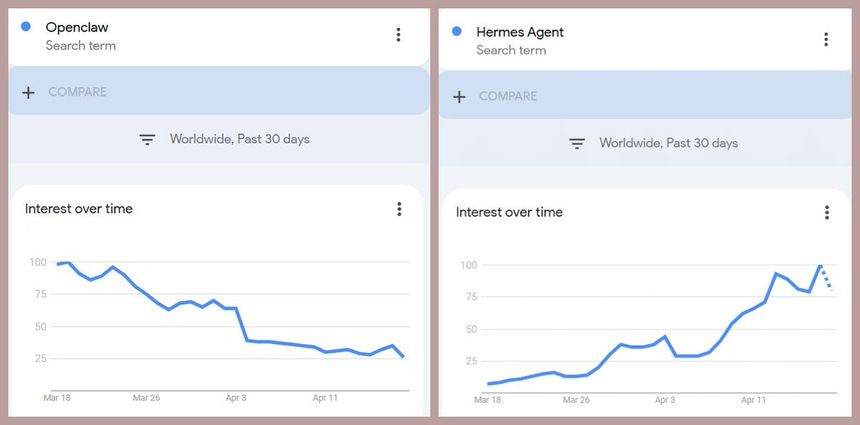
Now, 4 months later, it seems my initial impressions have played out exactly as I anticipated. OpenClaw interest has fallen off a cliff, Hermes usage has skyrocketed, and the sharp edges I initially encountered testing Hermes have been smoothed out as the Nous Research team continues to ship new fixes and features every week.
This week’s post is an overview of Hermes Agent: the OpenClaw alternative that you should use instead.
Hire me as CTO or tech lead for your next project.
Focus on growing the business, never worry about the tech again.
Slide into my DMs on X or Substack. Select portfolio at Deca Labs.
Next-Gen Agent Harness, Refined
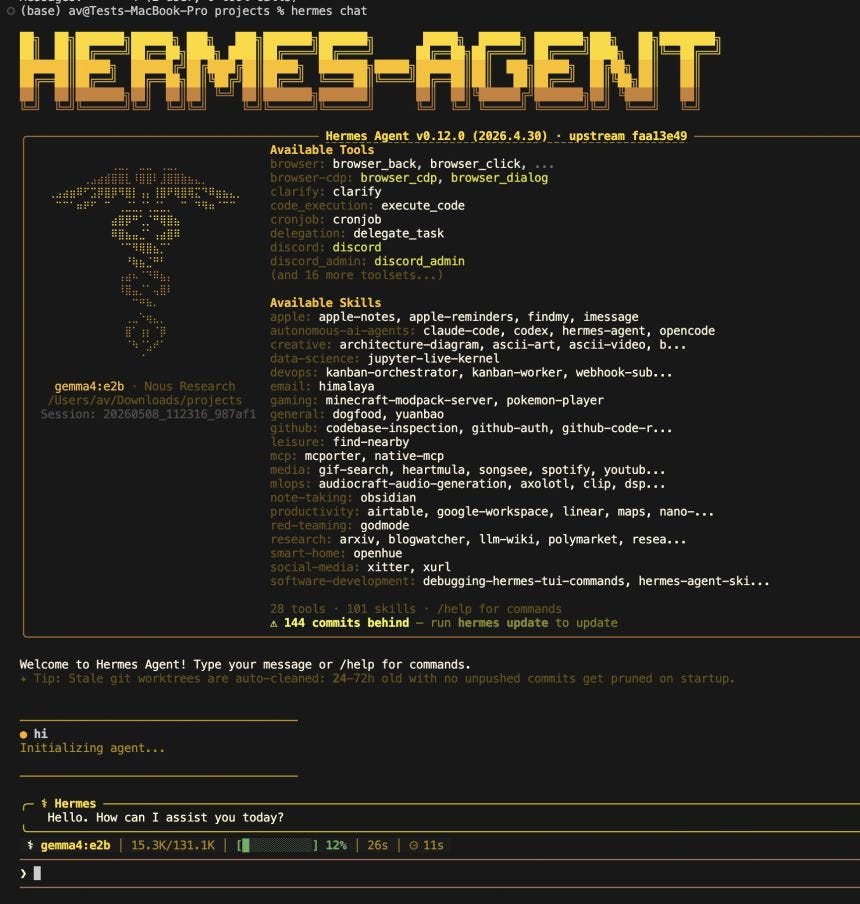
Hermes builds on the new paradigm pioneered by OpenClaw of an always running AI agent loop on a dedicated local Mac Mini or cloud VM, and takes a fresh approach to many of the core paradigms.
Instead of solely markdown files for memory management, Hermes leverages an on disk database to have much faster recall performance for searching past conversations and resources. In practice, it ends up feeling faster and delivering better results than OpenClaw which often feels limited in speed and ability by relying solely on Markdown files on disk.
Instead of a simplistic hourly heartbeat, Hermes ships with full cron job support allowing it to avoid the much reported sky high AI token bills from easily building up a heavyweight heartbeat file which blows through tokens every hourly run.
In practice this means that a heartbeat file which includes “at 5pm every day, summarize and do this” ends up burning tokens in and out to process that job, think how to check the current time, call the Unix command through a tool interface to get the time, determine if it’s 5pm yet, and finally after all those tokens burned it may go and burn more tokens to run the task.
Hermes in contrast taps into an actual cron job framework which leverages on harness and OS cron primitives to avoid needless token burn to try and force a non-deterministic AI system to act like a deterministic cron manager.
Model configuration and support is robust, with the ability to specify primary and fallback model providers, and specify models for specialized “auxiliary” tasks including processing images, voice input, and summarizing an existing conversation for context compression. In some cases you could want to handle most simple tasks with a cheaper, faster, or local model and only delegate to a more robust frontier model for complex tasks, Hermes supports that too.
And of course, Hermes comes with built-in support for many gateways like Telegram and Slack so you can talk to it from within existing apps you already use.
Use Poaster’s custom AI model to pull the best quotes from your long form writing, and automatically post them to your socials.
Skip the army of virtual assistants, start today for $1/month.
Security & Warning
Hermes gives you full configurability of which models you use, including use of Ollama for local models for example. I currently use OpenRouter and Z GLM 5.2 as my primary model, with fallback to Ollama local Qwen3.6-35b (base or obliterated/uncensored) for certain projects blocked by hosted models or sensitive data handling.
NOTE: I would highly recommend using a dedicated computer, and login accounts, for Hermes or any similar agent. There have been times in my testing, and in others, where it ends up going haywire and messing something up, and having a separate computer and accounts gives you better ability to limit data access and blast radius if something goes wrong.
Thank you to the readers who pay to make this newsletter possible.
Ready to turn your life around? Subscribe & start here and report back your wins.
– Fullstack
This Substack is reader-supported. To receive new posts and support my work, consider becoming a free or paid subscriber.
Limitations
One feature I’m still waiting on is specific model delegation configuration for programming tasks, since some of the small, cheap models are great for general research, tool calling, and as primary agent for Hermes, but fall apart when they encounter complex programming tasks. Being able to specify a fallback model for software engineering tasks specifically would be a big unlock.
Nous Research has proven to be surprisingly open to community contributions. Their Slack integration was initially quite rough with notable, reproducible bugs. But with Hermes, I was able to debug, open a new PR, and even answer PR feedback from their team without ever manually putting my hands to a keyboard. Hermes managed it all end to end, guided by conversational chat through Slack and Telegram. So far, I’ve gotten 5 PRs merged which now make the Slack integration usable and a powerful frontend to interact with Hermes.
Skills & Self-Learning
While some may see it as a limitation compared to OpenClaw, I see the lack of a Skills marketplace to be a distinct advantage to Hermes. While the OpenClaw Skills marketplace sticks tightly to the historical software guidance of DRY (Don’t Repeat Yourself) and paradigm of publishing reusable software (some skills are even paid), the lack of any quality filter or trusted source has led to a tragedy of the commons where none of the skills can be naively trusted, with over 40% from one audit having security vulnerabilities or being outright malicious through whitespace, character encoding, or other clever prompt injection attacks.
Hermes instead tries a more AI native approach of making generating your own skills so fast, easy, and implicit that you don’t even think of needing access to someone else’s published skills.
Hermes analyzes conversations and if a conversation leads to a task which it thinks may be useful in the future, it builds its own skill to speed up and improve future task performance. In practice, this has proven genuinely useful.
When doing research or financial modelling recently for a car purchase and some investment portfolio rebalancing, after the first conversation Hermes messaged that it had created a skill for it. And in subsequent conversations, without explicitly asking it to use a skill, it would notice from the prompt similarity to past conversations and immediately leverage the skill to get to the results I was looking for with less tokens and time.
Where OpenClaw often seems to try and push AI models beyond their current capabilities, Hermes leverages a more structured harness, organic skill generation, and DB backed memory management approach to use AI where it shines, and fallback on traditional deterministic computing paradigms.
The pragmatic philosophy of Nous Research and less romantic, ideological view of current model capabilities shows up again and again as you use Hermes for more complex tasks. In practice, it leads to improved real world performance and token efficiency, which as token costs at frontier labs continue to go up, and your usage goes up over time, will become a consideration of increasing importance.
Profiles
A recent addition to Hermes was Profiles, which let’s you setup virtually isolated Hermes instances on the same host to ensure better data and skill isolation.
For example, I use my default profile for my personal agent usage but setup a different profile for my W2 to largely ensure data isolation between the two.
This means that on the same hardware, I can have a “personal Hermes” I use through my personal Telegram and Slack, and a separate “W2 work Hermes” I use through a separate Slack bot that I managed to get installed on my W2’s corporate Slack. (“If you’re famous, they just let you do it.”)
While having a chat assistant in Slack seems largely useless, it has in practice let me automate large parts of my job, and do most of it on my phone from Slack, which has been huge. I’m now free again from being chained to my keyboard prompting Claude Code all day (or Codex through Conductor).
Use Cases
Some good advice I heard from the true believers pushing AI at the big tech W2: “whatever you’re going to try, just see if AI can do it”.
For years, this was aggravating and frustrating advice because the models and harness for agents were still so bad. But in 2026, models are good enough, and agent harnesses like Hermes are good enough to start to do some genuinely useful work, autonomously.
Let’s walk through some examples showcasing increasingly difficult problems and how Hermes with current models like Z GLM 5.2, can handle them consistently well.
Continue reading this post for free, courtesy of BowTied Fullstack.