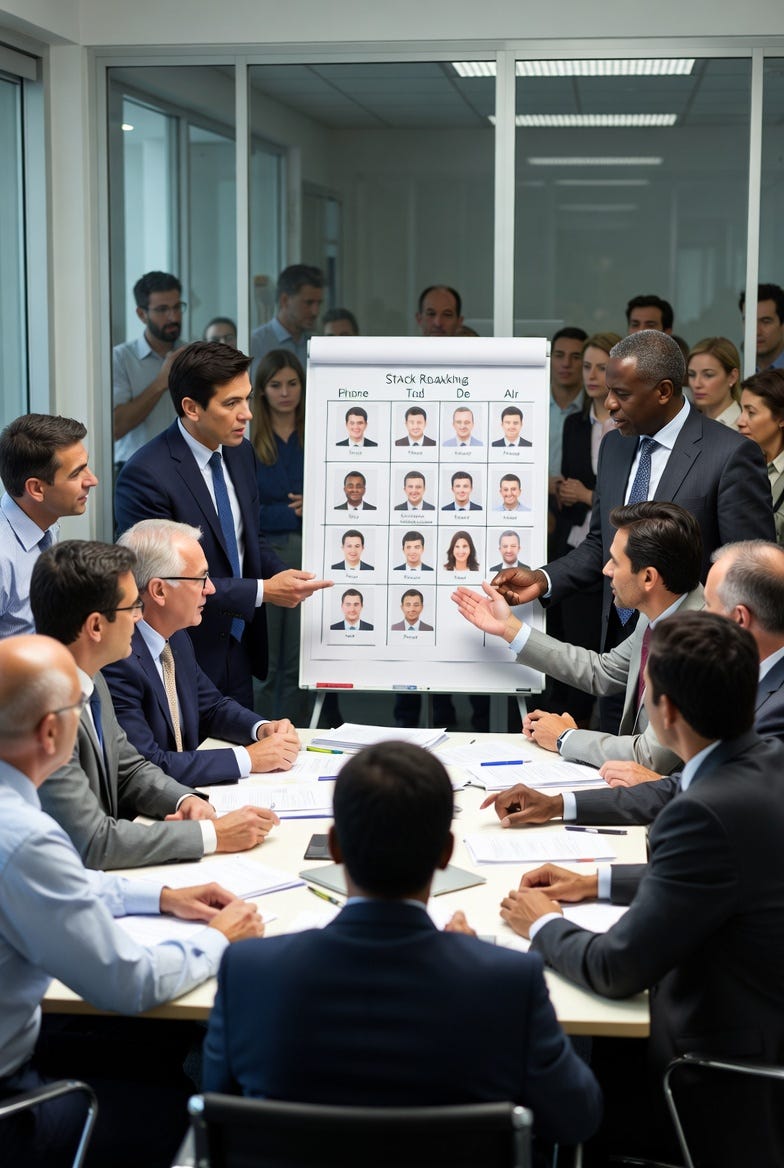
If a tech company lasts into its second decade, it seems like a matter of fate that leadership falls for the temptation of the tyrannical management tactics of General Electric in the 1980s or Microsoft in the 2000s or Amazon in the 2010s.
Today, your introduction to the ever looming “stack rank” tactics, which are always Coming Soon TM, and how you can still win despite the hysteria that will grip both your colleagues and manager.
Hire me as CTO or tech lead for your next project.
Focus on growing the business, never worry about the tech again.
Slide into my DMs on X or Substack. Select portfolio at Deca Labs.
What is “Stack Rank”?
“Stack ranking” is a performance management technique of bucketing employees into top performers, then good performers, then average, then below average, then poor. The poor and sometimes below average are PIP’d out, and then 6-12 months later the cycle begins again.
While the bucket names may vary by company, the technique has been tantalizing for management since it first became famous under CEO of General Electric, Jack Welch, in the 1980s, who made a point of firing the bottom relative 10% of employees every year, regardless of how they were actually performing.
It always appears as the apple to Eve, delicious to eat. But even a single bite can destroy the culture of a company, because of the toxic incentives it introduces, which become nearly impossible to root out.
For example, when employees internalize that they will be ranked against their team members, or other employees at their same level, there now is an incentive to not openly collaborate, even to obstruct or sabotage other’s projects to make yours stand out.
The longer it lasts, the more rounds employees are put through, the harder it is for the survivors to avoid becoming crabs in a bucket, nipping at each other to avoid getting cut next round.
Use Poaster’s custom AI model to pull the best quotes from your long form writing, and automatically post them to your socials.
Skip the army of virtual assistants, start today for $1/month.
As detailed in the Vanity Fair 2012 case study on Microsoft’s adoption of stack ranking in the 2000s under CEO Steve Balmer, many of the spectacular failures of the Balmer era (remember Windows Vista? Zune? Windows Phone?) could trace back to the corrosive nature of stack rank on the culture of collaboration, an endless stream of public failures as employees at each opportunity failed to work together to solve problems before launch, or speak honestly of problems emerging before they had metastasized to disrupt the entire roadmap.
While Microsoft softened the practice post-Balmer, other companies like Amazon have stuck with it, even dialling up the heat with “calibrations.” Managers make their initial assessments of their team, but then during weeks of closed door “calibration” meetings, managers fight it out against each other, supervised by their director, arguing to protect their team against the other managers itching to fire other’s engineers, since it means they can maybe keep their prized engineer.
Often, managers end up choosing scape goats to sacrifice or throw under the bus during the negotiations to protect their top team members. Worse still, some go a step further and treat hiring as “Dinner for Schmucks”, deliberately hiring a low performer so they have an easy mark come next round when they need to protect their top performers again.
Safe to say, even the best managers often fail at this, and many a good engineer end up laid off amongst the cross-fire. The engineers that last through this, are molded by it. Amazon and Microsoft engineers have become notorious industry-wide for the combative and ruthless approach they bring with them, even when they leave for another company which doesn’t use stack rank.
In engineering especially, fostering competition amongst engineers is a sure way to slow velocity, kill reliability and quality, besides destroying morale.
And yet your W2 will probably try it, especially if the stock price or internal valuation models drops low enough.
Ask me how I’ve learned so much about it? (My W2 adopted it in recent years.)
Thank you to the readers who pay to make this newsletter possible.
Ready to turn your life around? Subscribe & start here and report back your wins.
– Fullstack
This Substack is reader-supported. To receive new posts and support my work, consider becoming a free or paid subscriber.
How does it start?
So how do you know that it is starting? What are the warning signs?
First, interest rates go up.
What? Central bank policy causes my director to start “stack ranking”?
I’m serious, the end of ZIRP started the clock for many companies, and within months of rates rising, public and private valuations began to fall. This ripples into bigger investor focus on stock based compensation diluting their shares. Cheap debt and massive valuation rewards for future growth disappear, so management teams scramble to please Wall Street.
Actual high performing teams don’t need to talk about it
While most companies have some sort of annual performance chat with your manager before your annual raise (to keep you ahead of inflation if you’re meeting expectations), you can sense that stack ranking might be coming when the all hands meeting topics become more focused on performance.
In a healthy company, the focus is on the mission, the latest demos, the next projects, the opportunity. When companies turn inwards, and focus on “performance management”, the start of cost cutting is a sign that something has gone wrong.
Ironically, many top performing teams rarely need to discuss performance. They are already intrinsically pushing towards the frontier of their possible output, excited by the mission, the opportunity, and enjoying working with other “A” players who want to do the same.
The closest you’ll get is a Steve Jobs character coming to say that what you built isn’t good enough to ship, you can do better, you must do better; which is still far different in tone and substance than the HR and legal approved nonsense that you’ll hear spewed from many leaders when they breach the topic. Some will even be so nervous being the mouthpiece for the process that even the socially unaware autist engineers in the audience will pick up something is off.
Are you looking for 1:1 coaching (tech career, wifi-money, Canadian real estate)?
DM me on Substack or X with your topic, I’ll see if I can help. $120 for 30 mins.
– Fullstack
What you measure, will be gamed to death
Next, will come an increasingly fanatical and irrational focus on metrics.
Lines of code. Pull requests opened. Time from pull request open to merge. Number of deploys per week. Number of interviews. Number of AI tokens spent.
Do any of these actually signal high performance? Maybe. Can almost all be comically easily gamed by engineers? Obviously.
And so, instead of improving performance, velocity, or reliability, you incentivize engineers to focus on refactoring and splitting up one medium PR into 7 small PRs.
Or using corporate AI tokens to build personal side projects since token spend is all that matters, there’s no checks on what the tokens are being spent on.
When one metric becomes too obviously gamed, the midwit managers find another.
“Just one more metric bro, please, this one will work, I promise. One new metric in a new dashboard, that will solve our performance and morale. The engineers won’t be able to gamify this one bro, I promise. Please bro, just one more, this one will work, I know it...”
As anyone with above a room temperature IQ should know, “Show me the incentives, I’ll show you the outcomes.” When the incentive is to game the metrics, they will be.
And fight this all you want, but management sets the rules of the game. Your only power is to play it better than your colleagues.
Remember, you don’t need to be able to outrun a bear, you just need to be faster than your most annoying hiking companion.
The corporate surveillance state looms ahead
ChatGPT hadn’t even been out for a year, and Microsoft had introduced in 2024 a creepy AI feature called Recall where Windows would take a screenshot every few seconds, and then provide suggestions of how you could use your computer better. After backlash, they made it optional.
But that was simply the trial run with alpha models.
The next wave of coming corporate spyware will blow away all the key loggers, power hungry Crowdstrike daemons, and forced whole computer backups of today.
The next ones will be AI powered, include full screen capture analysis, and perform sentiment, time, and productivity analysis with such detail that managers will need to change their pants the first time they get access to the dashboards.
As I am keen to remind you, and myself, time is running out.
The corporate panopticon is closing in.
And we have years, not decades, to escape the W2 before life in the fishbowl becomes truly unbearable.
One could say the same about our increasingly surveilled and AI powered societies...
How to still win while in the W2 mines
So, how do you win in this hellish rat race? Can you even win?
You can win, and with these tactics below, you will.
Continue reading this post for free, courtesy of BowTied Fullstack.